Read the full story of Beatrice Ayer Patton in Lady of the Army and sign up to be notified when The Lady Who Shines: Joanne Holbrook Patton’s Life of Service becomes available.
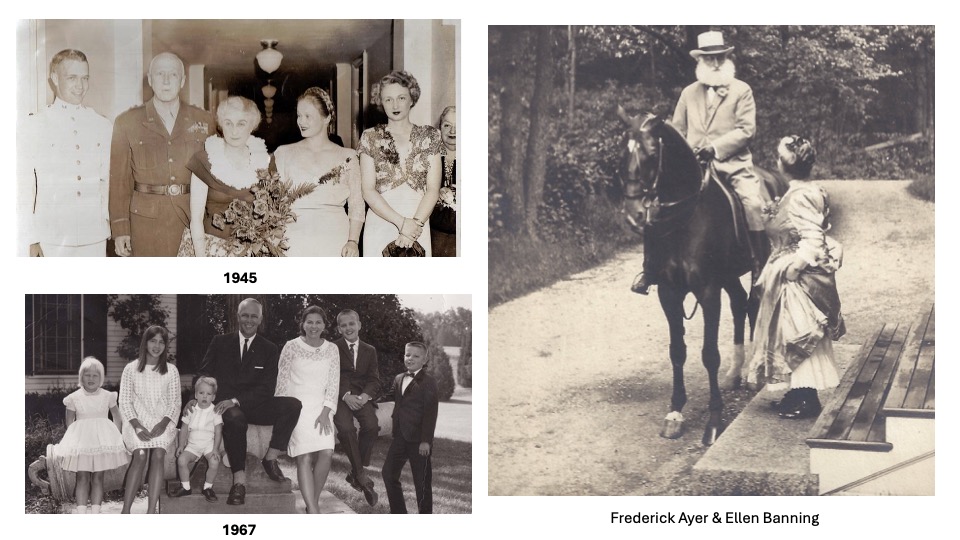
The Patton Homestead in Hamilton, Massachusetts, has long been a place where history, family, and community converge. For three generations, the Patton family has called this land home, finding spiritual solace during times of crisis and showing a deep respect for the environment.
The story of the Patton Homestead is closely tied to the women who had a significant impact on it. Beatrice Ayer Patton and her daughter-in-law, Joanne Holbrook Patton, each brought their own unique vision to Green Meadows. Beatrice offered stability to the family during challenging times of war and loss, while Joanne transformed the land into a center of innovation and community.
The colonial farmhouse, built in 1786, is located on the border between Hamilton and Topsfield, a rural community about thirty miles north of Boston, renowned for its equestrian heritage. The Burroughs family purchased the estate at the turn of the twentieth century and named it Green Meadows in honor of the beautiful fields that surround the two-and-a-half-story house.
After Mr. Burroughs died in a plane crash in 1925, his widow auctioned their home, creating challenges for the hunting community she had long been part of. Older landowners permitted Myopia Hunt Club members access through their properties, but outsiders might not be as accommodating. Beatrice’s brothers, Frederick and Chilly Ayer, believed such dedicated equestrians as the Pattons would be ideal stewards for Green Meadows and would likely support the club’s interests. Thus, the Ayers sought to acquire the property.
After all, the Pattons were searching for a permanent home around that time, having moved from one army base to another for sixteen years. Although they would continue to move, George felt it was time to find a place of their own, ideally near Beatrice’s family. This way, she would be surrounded by friends and loved ones when he left for the war he knew was inevitably on the horizon.
In 1855, Patriarch Frederick Ayer had moved to the area to join his brother in the patent medicine business and later founded the American Woolen Company in Lowell. Beatrice was born there in 1886 before the family relocated to two new developments in Boston and Pride’s Crossing, just a few miles from where the Pattons got married in 1910. With all but one of her six siblings living nearby on the North Shore, it was no surprise that the Pattons acquired Green Meadows in January 1927.
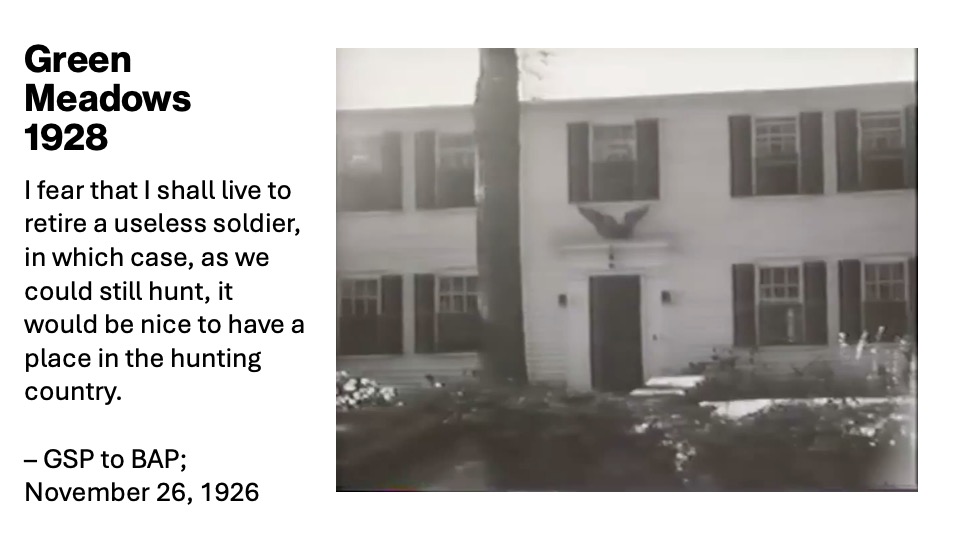
The Patton family—Beatrice, George, and their three children—first visited Green Meadows after returning from Hawaii in 1928. They undertook extensive renovations to modernize the home, primarily using it as a vacation property for the next fifteen years. The longest time Beatrice and George spent together at the house was in the latter half of 1938, after he suffered a broken leg that resulted in a severe case of phlebitis. With a pond in the backyard and the Ipswich River flowing through the property, it was no surprise that his horse had been startled by one of the many mosquitoes that plagued the area.
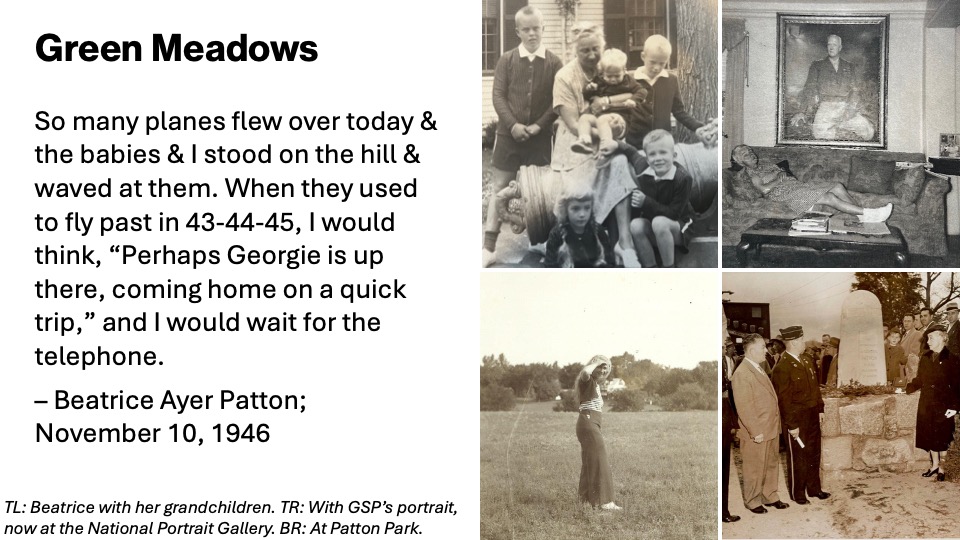
Green Meadows fulfilled its primary purpose during World War II, serving as a place of support and retreat for Beatrice and her daughters, whose husbands were also fighting in Europe. Journalists often visited 650 Asbury Street to inquire about General Patton’s exploits, more frequently during times of controversy than during periods of success. In 1943, Beatrice was called to the local train station and asked to bring along six strong men. Her husband had sent a cannon from Morocco, which remains in the backyard to this day, pointed toward the Ipswich River to deter potential pirates.
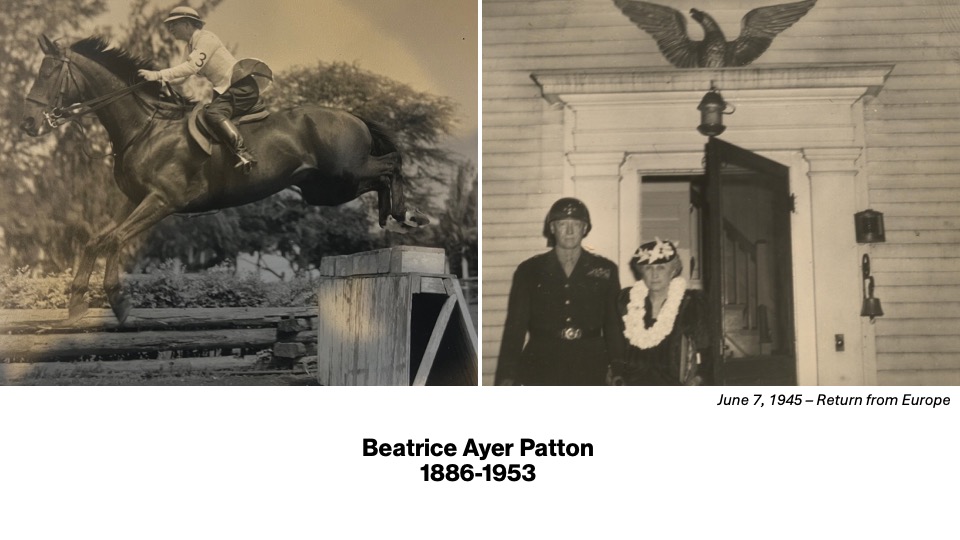
After a triumphant return to the United States in June 1945, General Patton spent a few weeks with his wife at Green Meadows. This period provided a glimpse of what life might be like after his retirement, a significant decision he was suddenly forced to confront when he was reassigned from the Third Army to the Fifteenth Army in September 1945. Tragically, just before his return home, on December 9, he was injured in a car accident in Germany. Instead of celebrating Christmas together for the first time in five years, Beatrice traveled to Heidelberg, where General Patton fought for his life for twelve days before passing away at the age of sixty.
After her husband’s burial in Hamm, Luxembourg, Beatrice was left to face the future alone at Green Meadows. A skilled sailor and equestrian, she spent her final years tending to her garden, taking care of her grandchildren, and riding horses, all while promoting her husband’s legacy around the world. She passed away in 1953 while participating in a hunt with the Myopia Hunt Club on her brother’s farm in nearby Wenham. Green Meadows’s legacy, however, would carry on through the young woman who had recently joined the family.
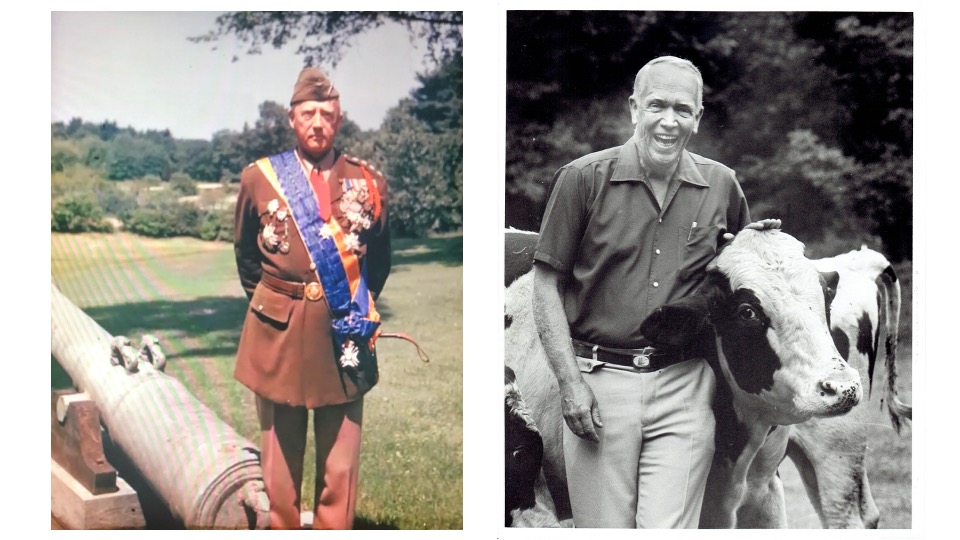
Joanne Holbrook married George Patton IV in 1952, marking the beginning of a new chapter in the Homestead’s story. Taking over one’s mother-in-law’s house is never easy, but Joanne quickly fell in love, often saying, “Can you tell how happy I am here?” Like Beatrice, Joanne found in Green Meadows the grounding that a life of constant moves denied her. For an Army wife who would relocate forty-four times, the Homestead became a permanent base—a sanctuary of peace, freedom, and joy to return to over the summer as the children grew up.
Joanne’s background prepared her for a life dedicated to service. As the daughter of an Army general, she grew up immersed in the rhythms of military life, which instilled in her both resilience and a sense of belonging to a greater mission. During her years as an Army wife, she took on a leadership role in Army Community Service, where she professionalized volunteer networks that supported soldiers’ families worldwide. The skills she developed in these positions—organizing, advocating, and building community—ultimately shaped her work at Green Meadows, where serving others remained at the core of her mission.
When Major General Patton retired in 1980, the family returned home for good. Joanne opened her own company in one wing of the house, naming it Patton Consultant Services, which professionalized her years of volunteer experience. Meanwhile, George felt it was time to make their land productive, declaring that it should no longer be used solely for leisure. What began as a single blueberry patch grew into a thriving business, with the fields named in honor of the men George had lost in Vietnam. This served as a permanent reminder of the legacy of service that had been a part of the Patton family for generations, and the impact it leaves on those who serve.
When her husband could no longer manage Green Meadows Farm due to illness, Joanne took over the day-to-day operations of the business. Despite having failed her Botanicals class in college, she made the bold decision to give up her own business and transform Green Meadows Farm into an organic one, becoming one of the first in Massachusetts to do so. What initially began as a pick-your-own blueberry farm had now evolved into a Community Farm Share that served three hundred families.
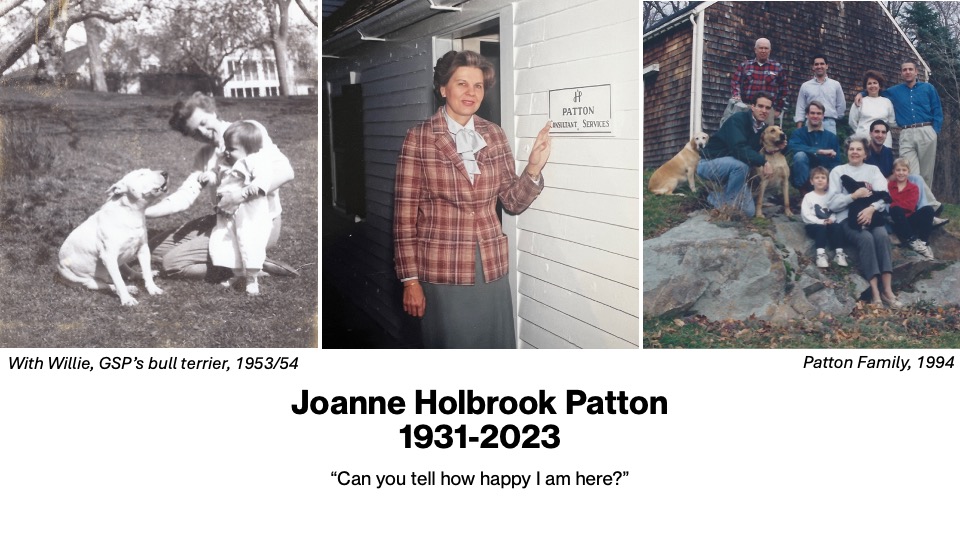
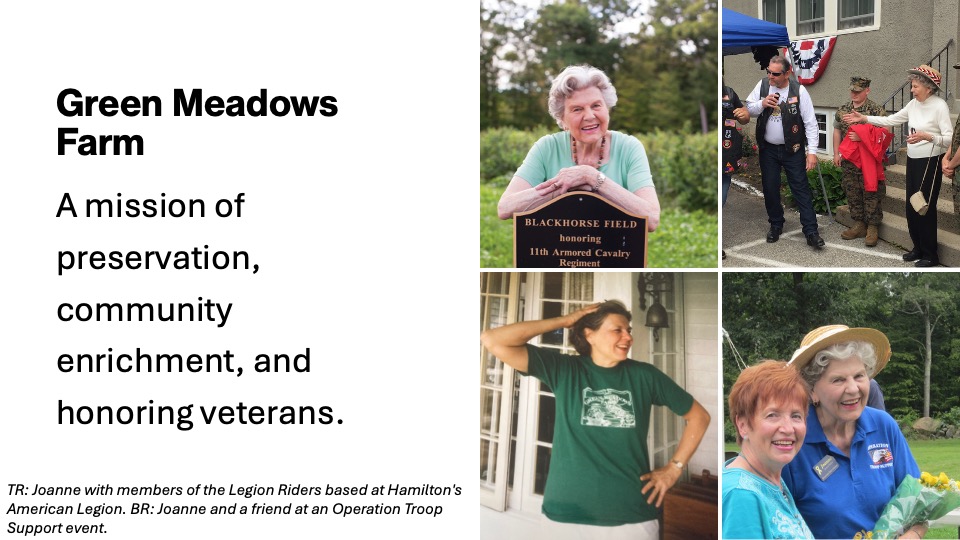
By 2012, at the age of eighty-one, Joanne decided to gift her home and land to the town of Hamilton. Having spent her entire life helping others, she felt a strong commitment to preservation, community enrichment, and honoring veterans. To her, the Homestead represented more than just private property; it was a place where stories of sacrifice and resilience could inspire future generations. For years, she had organized veteran-related events in the vast backyard, from Operation Troop Support to reunions of the 11th Armored Division.
By placing the estate in the public’s hands, she ensured that it would serve not just one family but become a shared resource: a gathering place for civic life, a living classroom for history, and a site for reflection on military service. Through this gift, Joanne extended her lifelong dedication to service, transforming her personal legacy into a community legacy.
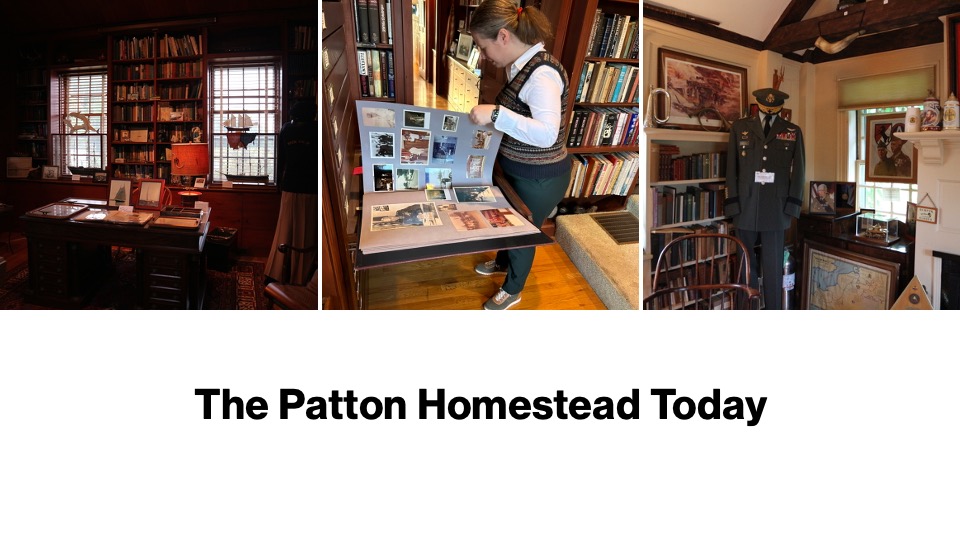
Since then, the Homestead has hosted events that honor Joanne’s vision. These include Military Service Day, which brings together veterans and their families to recognize their service; educational tours that connect students to military and local history; and community programs that celebrate the arts, farming, and the environment.
So, what can you do? Visit the Homestead and share its story. Support community programs and participate in events like Military Service Day. Reflect on your connection to the land, family, and service. Become a living link between the past and the future.
Read the full story of Beatrice Ayer Patton in Lady of the Army and sign up to be notified when The Lady Who Shines: Joanne Holbrook Patton’s Life of Service becomes available.
 Minnegate Press
Leave a Reply