Part 1 – A Freak Accident, a Devoted Wife, and the Death of General Patton.
When confronted with the question of her husband’s final resting place, Beatrice Ayer Patton’s first thought was to have his body brought to the U.S. for burial at West Point. It was her grief speaking because she knew better than anyone that General George Patton didn’t want to be brought home. According to him, burying a soldier anywhere but the place he fell was catering “to a bunch of snivelling [sic] sob sisters retained by those carrion-eating ghouls, the coffin makers and undertakers.”
When General Eisenhower learned of Beatrice’s intentions, he knew there was a possibility “the public might demand that Patton be returned to the United States for burial.” Still, the Army had not repatriated a single officer or soldier during or since the war. General Keyes, a close family friend who’d spent the last two weeks with the Pattons at the 130th Station Hospital, was asked to “voluntarily” change Beatrice’s mind. Uncomfortable doing so, he asked the neurosurgeon who’d accompanied Beatrice from the U.S. to do so instead.
Beatrice’s reaction was immediate when Colonel Spurling broached the subject, “Of course he must be buried here! Why didn’t I think of it? Furthermore, I know George would want to lie beside the men of his Army who have fallen.” Given the choice of three locations, she chose the as-yet-unfinished-and-unnamed Luxembourg American Cemetery in Hamm; it was where General Patton had fought his hardest battle and where the Third Army had lost most of its men.
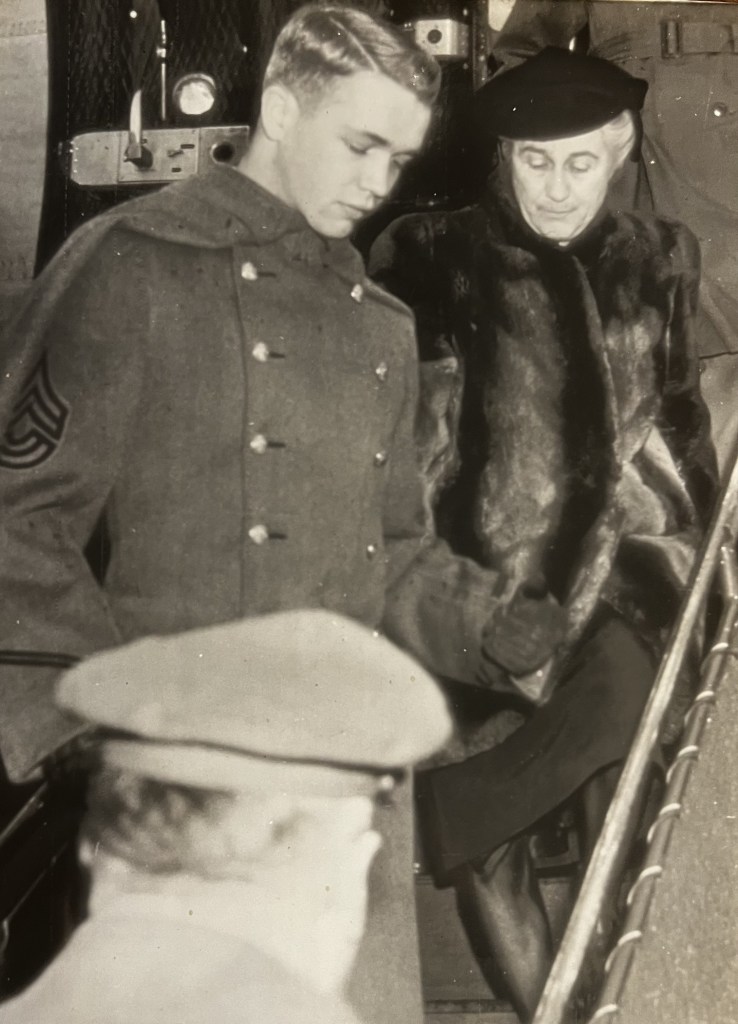
After mass at Christ Episcopal Church in Heidelberg on December 23—a detailed account can be read in Lady of the Army: The Life of Mrs. George S. Patton—the funeral procession made its way to the train station, where General McNarney’s train waited to begin the 240-mile journey to Luxembourg. Fred Ayer was amazed at his sister’s fortitude during the thirteen-hour ride as Beatrice “stepped out on the platform” at every stop no matter the hour and “made a short speech in French, thanking the troops for their tribute to George.”
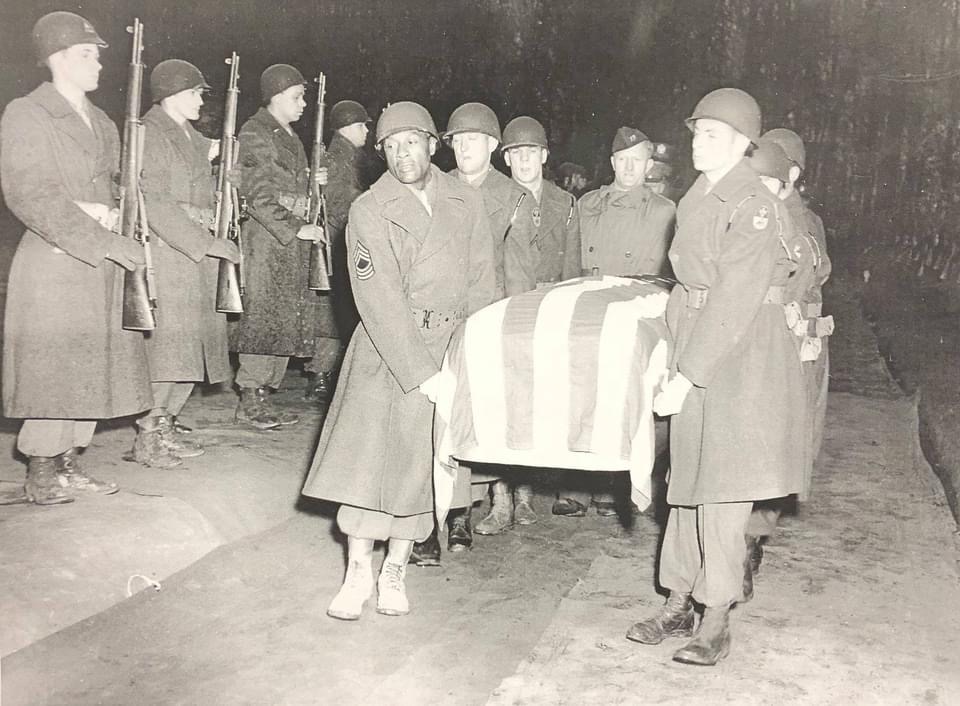
When the train arrived at the Luxembourg Station at 5:30 a.m. on December 24, it had finally stopped raining. The procession from the station to the Hamm Cemetery, which passed a mere two blocks from George’s command post during the Battle of the Bulge, consisted of a motorcycle escort, twenty-one French armored cars, seventeen American jeeps, five American armored cars, the half-track bearing George’s body, and several black limousines with dignitaries from eleven nations. The citizens of Luxembourg walked the four miles behind the funeral cortège in respect to their ‘liberator.’
Six hundred soldiers of the Third Army lined the road from the cemetery’s entrance to grave No. 7934, dug the day before by a group of German POWs and located next to Private John Przywara from Detroit, killed on the first day of the Battle of the Bulge. A freezing wind blew across the open field, and the ground was as muddy and wet as it had been a year earlier. Still, the flower arrangements were so copious they covered an area thirty feet long and four feet high; ironically, the largest wreath came from the Russian delegation.
Only once did Beatrice lose control during the short ceremony, as she repeated the words of the Lord’s Prayer, but no one could fail to notice how her shoulders heaved with each shot of the 17-gun salute. A lone bugler sounded Taps—“the last goodnight,” as Beatrice called it—and the flag covering the casket was folded into the traditional three-cornered shape. As M/Sgt. Meeks handed the flag to Beatrice and he saluted her, their misty eyes met for a brief moment, “exchanging a final message of condolence.”
“If I should conk,” George had written his brother-in-law Fred Ayer at the start of Operation Husky in July 1943, “I do not wish to be disintered [sic] after the war. It would be far more pleasant to my ghostly future to lie among my soldiers than to rest in the sanctimonious precincts of a civilian cemetery.” This was a belief George shared with almost any country in the world—bury the war dead where they have fallen—but ever since WWI, the United States had a different opinion.
On May 16, 1946, Congress passed Public Law 383, allocating $200 million to repatriate any of the 279,867 heroes currently resting in temporary graves across Europe and the Pacific if their families wished so. Beatrice vehemently opposed this action, believing that someday, when Americans visited their loved ones overseas, they would conclude that it is “completely right that he should lie there…Every good soldier I have ever known wanted to be buried where he fell. Mine did. Our dead have earned the right to rest in peace.”
Buried amid his soldiers with total disregard for rank, however, it quickly became apparent that visitors who came to pay their respect to General Patton were trampling the surrounding graves. Even though the American Battle Monuments Commission (ABMC), in charge of the fifteen American cemeteries overseas, was still working on the final plan for the Luxembourg American Cemetery, in 1946, they suggested moving George’s body to lie at the head of his men. Assured this would be the final move, Beatrice reluctantly agreed.
“The members of the Patton family acquiesce and concur with the reasons underlying the general rule that burials shall be made without regard to rank, race, creed, or color; however, in the case of General Patton, his grave was changed from a position in one of the regular plots to its present location not because of his high rank but to get it completely away from the proximity of the other graves in order to avoid their desecration.”
Commander Keith Merrill—General Patton’s brother-in-law—to General Bradley when discussing a potential second move in 1948.
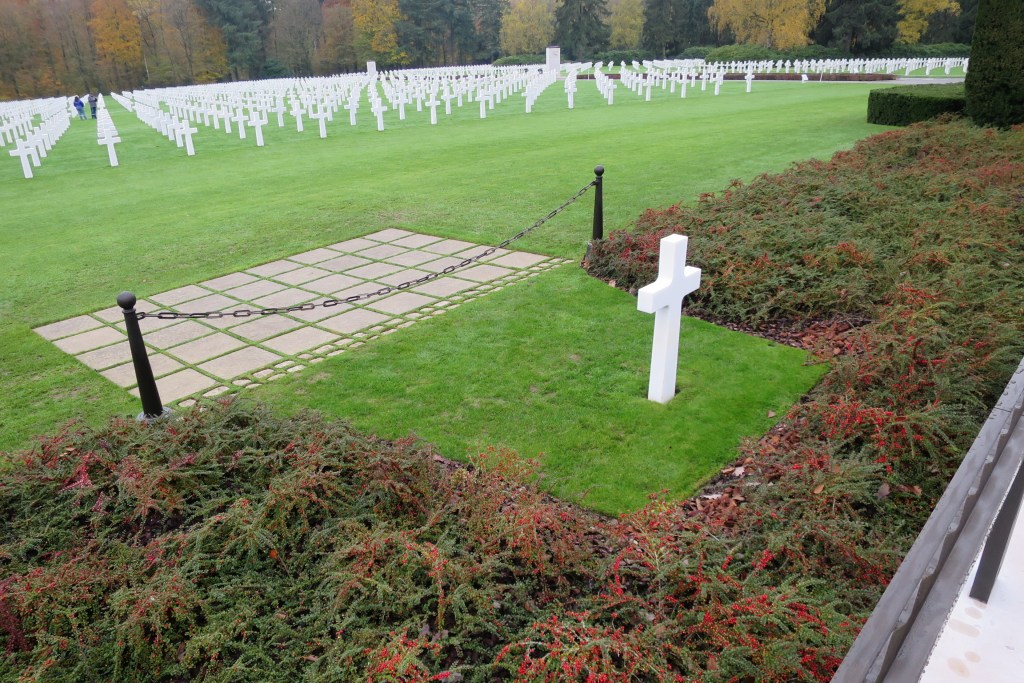
When visitors pay their respect at the Luxembourg American Cemetery today, they find General Patton’s grave at the head of his men who died in the Battle of the Bulge and the fight for the Rhine. Entering through the gates of the cemetery, visitors stand on top of a stone terrace overlooking the graves of the 5,070 soldiers who were not repatriated; a Memorial Chapel and two stone pylons serve as a reminder of the sacrifices made by those who serve in the military. To this day, in addition to the ABMC, the graves are cared for by the grateful citizens of the Grand Duchy of Luxembourg.


 Minnegate Press
Leave a reply to Lupita Garcia Cancel reply